






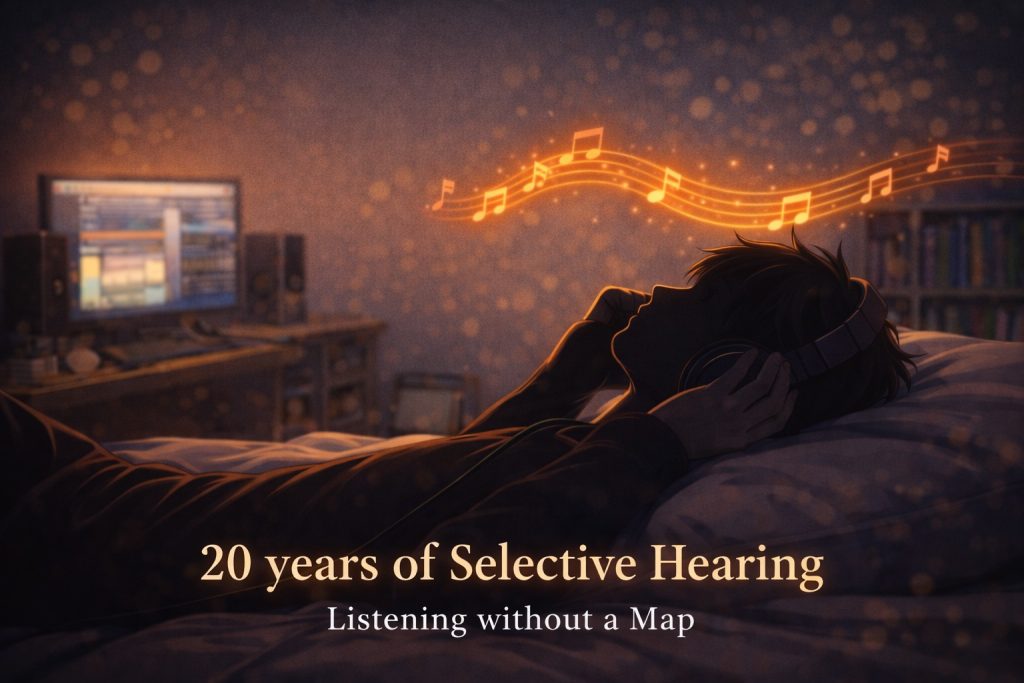
As the 20th anniversary of Selective Hearing continues, it felt like the right time to look back at how I discovered and got access to Japanese and Korean music. I’ve been around long enough to witness major shifts in how music is delivered, discovered, and consumed. Technology has reshaped that experience in countless ways — some of them undeniably positive, others a little more complicated.
Allow me to sound like the old-timer in the room: back in 2006, finding new music — especially from Japan and Korea — wasn’t nearly as convenient as it is today. It required a bit of effort, whether that meant digging through forums and blogs or tracking down local shops that imported music from overseas. Discovery was slower, often expensive, and sometimes frustrating, but it also felt intentional in a way that’s harder to replicate now.
Nothing quite matched the sense of accomplishment that came from finally holding a cassette or CD you’d worked so hard to track down and then playing it to death after.
While physical music media is still common and widely available in Japan and Korea, its perceived value has shifted in the era of digital distribution and instant gratification. In my experience, dedicated collectors and longtime fans still place real importance on owning physical copies of their favourite artists’ work. For many others, however, physical editions of singles and albums have become little more than elaborate placeholders for photo cards, or transactional requirements tied to fan events.
But I digress — I actually find the shift from physical to digital music advantageous in many ways. No longer does precious living space need to be taken up by stacks of CDs or vinyl, which is especially welcome if you live somewhere where space is at a premium. If you’re a music hoarder like me, it’s far easier to store large collections across portable hard drives, USB sticks, or NAS units. And if you’re primarily a streaming listener, the only real requirement is a stable internet connection.
The biggest advantage of the digital era is how much easier it’s become to discover new and interesting music. While social media still plays a role in recommendations, there’s something freeing about having access to an almost limitless catalogue of artists’ work for a relatively low monthly or annual subscription. It’s undeniably more affordable and far more convenient than anything that came before it.
Of course, that level of access comes with its own downsides. The main one I’ve encountered is simply being overwhelmed by the sheer volume of what’s available. My background is rooted in DJ culture, where the constant search for something new and fresh comes naturally after years of crate digging. Even with my listening narrowed to a handful of genres, there’s still far more music than there’s time to meaningfully absorb.
In some ways, that problem has resolved itself. Much of today’s popular music simply isn’t very memorable, and that isn’t meant as a shot — it’s more a reflection of the environment it exists in. The enshitification of popular music has pushed songs toward bite-sized, platform-optimised formats, often at the expense of depth or longevity. As a result, when something does manage to stand out, there’s usually a good reason for it — and that’s what ultimately catches my attention.
This pretty much defines my current listening and discovery habits. Over time, I’ve learned to filter out the noise and trust my instincts. That usually means giving a song or album one or two listens to get a sense of the overall vibe, then deciding whether it’s worth returning to later for a deeper dive — and possibly a write-up for the site.
Sometimes I’ll go off the grid entirely and click on something purely because the cover art or title catches my eye. And these days, I don’t feel the same obligation to stay perfectly on top of everything as I once did. If I miss something or end up reviewing it late, so be it. I’m far more interested in finding music that adds long-term value to my library than chasing the flavour of the week.
After twenty years, discovering new music has become less about keeping up and more about paying attention. While the pace is definitely faster, the curiosity that keeps me hitting the play button hasn’t really changed at all. As long as there’s still something new to blast to eleven, I’ll keep going down the rabbit hole.